


Every new facility asks for the same details: name, age, allergies, medications. Sometimes even the same facility, between two visits. Why, what it costs, and what helps.
Every new facility asks for the same details: name, age, allergies, medications. Sometimes even the same facility, between two visits.
The repeated form is nobody’s stupidity. It results from every place running its own system, with no safe way to move patient data with consent.
In short:
- Forms repeat because each facility keeps its own records, and there is rarely a safe, consent-based way to bring yours along.
- Patients pay in time and transfer errors; clinics pay in longer intake, incomplete data and staff time.
- Until records move with you, a one-page summary you fill in once, and copy from at every desk, saves the most retyping.
Why does every medical form ask the same questions?
Because each clinic, lab and hospital keeps its own records, and there is rarely a safe, consent-based way for your details to travel from one to the next. Some of the asking is also deliberate: medicines and allergies change, and checking them before anything new is prescribed is a basic safety step. The waste is not in the checking. It is in writing everything out again, from memory, at every desk.
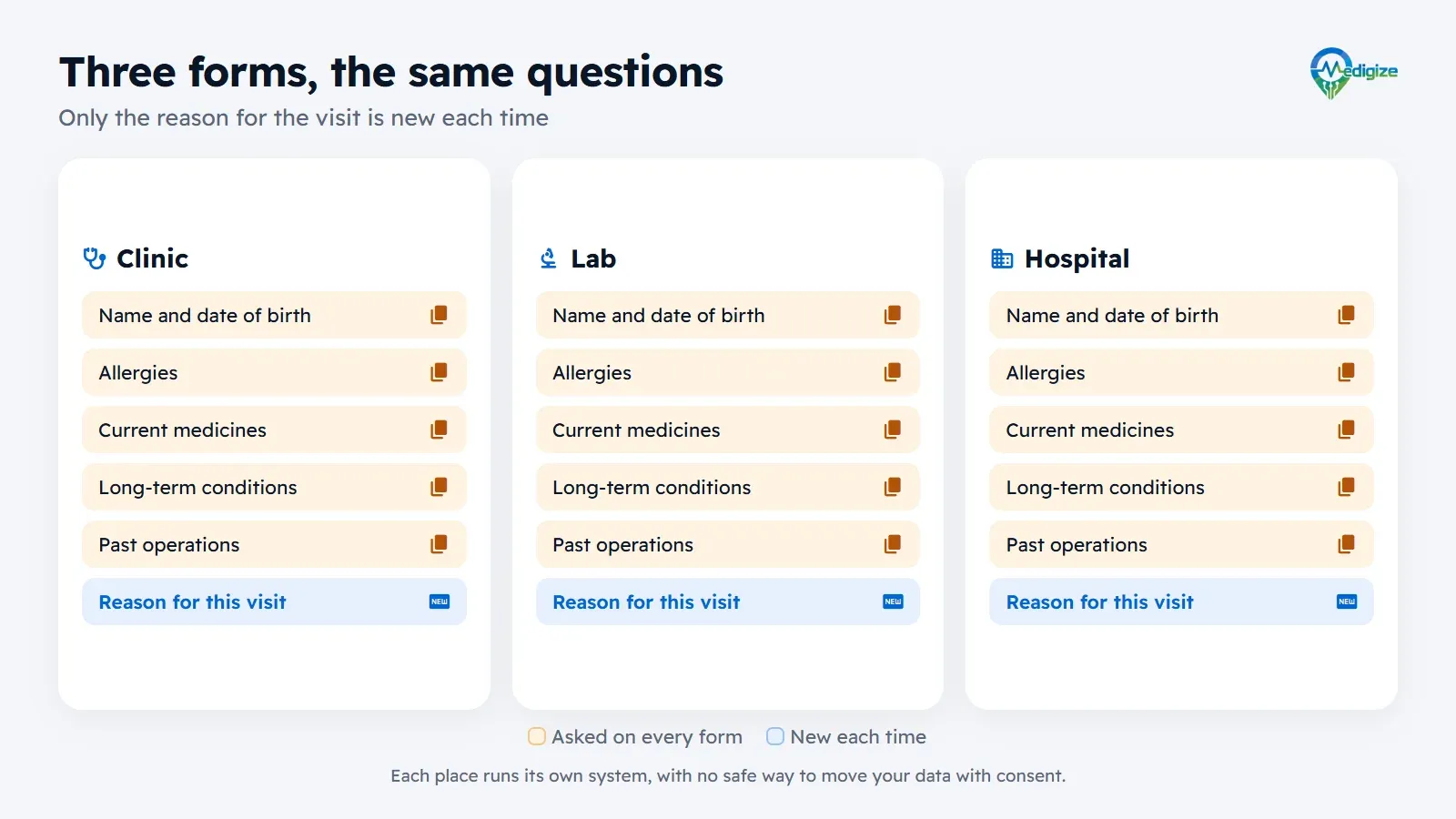
Three forms, the same questions. Only the reason for the visit is new.
The questions every form asks, and why each one is there
Put any two intake forms side by side and the overlap is striking:
- Name, date of birth and contact details
- Allergies
- Current medicines and their doses
- Long-term conditions
- Past operations and hospital stays
- The reason for this visit
Most of these change rarely. The reason for the visit is the one part that is new every time, and it is often the part with the least space on the form.
Each question has a job. Your name and date of birth make sure the record and the results are yours, not those of someone with a similar name. Allergies and current medicines are checked before anything new is given. Long-term conditions and past operations give the background that one visit cannot show. The questions are reasonable. Answering all of them from scratch, from memory, every time, is not.
Why it happens: three reasons
- Each place runs its own system. A clinic, a lab and a hospital rarely share one record.
- There is no safe road between them. Moving health data needs the patient’s consent and a secure way to send only what is needed.
- Re-asking feels safer than trusting an old copy. Staff ask again because they cannot know whether what they hold is still current, and for medicines and allergies, checking is the right instinct.
The World Health Organization’s 2019 report on medication safety in transitions of care describes the same gap from the medicines side: discrepancies are common whenever a patient moves between care settings.
The third reason is partly a safety step with a name. Medication reconciliation means comparing the full list of medicines a patient takes with what is planned in the new setting, so that nothing is left out, doubled or given at the wrong dose by mistake. The patient safety network of the US Agency for Healthcare Research and Quality (AHRQ) explains why it is needed: hospital clinicians may not be able to see a patient’s complete list from before admission, or may not know about recent changes. It also notes that discrepancies persist even in organisations with fully integrated electronic health records.
So the aim is not zero questions. The difference that matters is between confirming and retyping. Confirming is a short check of a list someone already holds: “Are these still your medicines and doses?” Retyping is the whole list again, from memory, and every rewrite is a chance for something to drop out.
What do repeated forms cost?
Patient time, manual transfer errors, and the feeling that the system does not see you. Providers pay too: longer intake and incomplete data.

Both sides of the desk pay for the same form.
There is one more cost that is easy to miss: staff time spent re-asking, which is time not spent on the patient.
Take a composite example, built from many cases: a woman in her sixties sees a specialist, has blood tests at a lab and a scan at a hospital, all in the same month. She fills in three forms. On the first she lists four medicines. On the second she forgets the one she started last week. On the third she copies a dose from an old prescription that has since changed. Nobody did anything wrong, and three places now hold three different lists. It is the gap the WHO report describes, at the scale of one person’s month.
The same gap shows up between clinicians. Describing care that is not coordinated, AHRQ notes that specialists do not consistently receive clear reasons for a referral, or enough information on tests that have already been done. Intake is the first of the five stages in what care operations means, and when it is weak, the visit opens with paperwork.
Fill it once: your one-page health summary
You cannot change how every facility works. You can make every form faster and more accurate by keeping one page with the details forms always ask for, and bringing it with you.
Start with your medicine boxes or prescriptions, any reports, and the names of the doctors you see. MedlinePlus, the health site of the US National Library of Medicine, suggests listing your allergies and every medicine, herb, vitamin and supplement you take. Copy names and doses from the box, not from memory, and if you know of no allergy, write “none I know of” rather than leaving a blank. Fill in what applies to you, then print it or copy it:
Try it
My health summary
The details forms ask for every time, on one page. Fill in what applies to you, then print it or keep a copy.
Your page
Your summary appears here as you fill it in.
Nothing you type is saved, not even in this browser, and nothing is sent unless you do it yourself. Update the page whenever a medicine or a condition changes.
Nothing you type in the tool is saved, not even in your browser. The page it gives you carries the date it was last updated, which tells the next reader how fresh it is.
Update it whenever a medicine or a condition changes, and keep your results with their dates, as described in questions to ask your doctor about your lab results. The fewer times you retell your story, the fewer chances for something to fall out of it, which is the point of Seven stops, and every one worked.
Then put the page to work:
- Copy from the page, not from memory. Or ask whether the clinic can keep a copy with your file.
- Ask for the form in advance. The US National Institute on Aging (NIA) suggests asking the doctor’s office to send the medical history form before your visit, so you can fill it in at home, where you have the time and the information you need.
- Say what changed. NIA suggests mentioning any recent changes in your medicines, and telling the doctor right away if you were treated in an emergency department or by a specialist since your last visit.
- Keep one for the people you look after. A parent or a child needs a page of their own.
Common mistakes on medical forms, and how to avoid them
- Describing a medicine instead of naming it. “The pressure pill” means nothing to the next reader. Write the name and the dose as printed on the box.
- Listing only prescribed medicines. Vitamins, herbal products and anything bought without a prescription belong on the list too.
- Leaving the allergy space blank. A blank can mean “none” or “not answered”. Write which.
- Copying last year’s form. An old list carries old doses.
- One word for the reason for the visit. Write a sentence: what, where, since when, and whether it is getting better or worse. The one-minute description in every patient journey starts with a question fits most boxes.
What can a clinic do to stop re-asking?
Several changes need no new system at all:
- Send the form before the visit, so patients fill it in at home with their papers to hand.
- Say what to bring when you confirm the appointment: the medicines or a list with doses, earlier results with their dates, and any referral letter.
- Split the form into three parts: what rarely changes, what must be confirmed every time (medicines and allergies), and what is new (the reason for the visit, which deserves the most room).
- For returning patients, confirm instead of re-asking. Show what you already hold and ask what has changed since the last visit.
This is close to what AHRQ means by care coordination: a patient’s needs and preferences known ahead of time and communicated at the right time to the right people. If you run a clinic and want to talk about intake before the visit, see Medigize for providers.
Can your records follow you from clinic to clinic?
In some places, they already do. In Dubai, the health authority runs NABIDH, an exchange that links healthcare facilities. Its published policy on patients’ rights says a patient’s information is shared with participating facilities unless the patient opts out of the exchange or of specific facilities, and that patients should be able to see their own information in a readable form, including electronically.
Elsewhere, the road still runs through the patient. A US guide from the Office of the National Coordinator for Health IT puts it in three steps: get your health record, check it, and use it, which includes sharing it with a new doctor. NIA notes that a new doctor will ask you to sign a release form before requesting your records from your former doctors: consent, on paper.
In Egypt, according to published legal commentary on the executive regulations of the Personal Data Protection Law, health data counts as sensitive personal data, and processing it needs explicit written consent. Rules like these protect patients, and they are part of why moving a record takes consent, a secure route and a clear limit on what is shared.
The right direction: confirm, don’t re-ask
Structured intake before the visit, and information that moves with the patient’s consent and with only the data that is needed. That is what Medigize works on in MIHOS and Medigize Dock, without claiming a connection to any specific system today.

Confirm, don’t re-ask.
- The patient describes the complaint once, before the visit.
- The essential details travel with it, only with the patient’s consent.
- Only the data needed for this visit is shared.
- The clinic receives the case already organised, and confirms rather than re-asks.
Notice what the four steps keep: the clinic still confirms. The aim is that the questions stay and the retyping goes. Read how we approach consent and data on our governance and privacy page, and the limits we hold ourselves to in three things we won’t build.
Frequently asked questions
Why do doctors ask the same questions again?
Partly because their system does not hold your earlier answers, and partly because details like medicines and allergies change. Confirming them is safer than assuming they have not.
What should a personal health summary include?
Your allergies, current medicines with their doses, long-term conditions, past operations and hospital stays, the doctors you see, and where your results are kept.
How can I fill in medical forms faster?
Keep a one-page summary and copy from it rather than from memory. Ask the clinic to send the form before your visit, so you can fill it in at home.
How often should I update my health summary?
Whenever a medicine, a dose, an allergy or a condition changes, and after any hospital stay. Check it before each appointment.
What is medication reconciliation?
A safety step in which clinicians compare the full list of medicines you take with what is planned in a new setting, such as admission to or discharge from hospital, so that nothing is left out, doubled or given at the wrong dose.
Is it safe to carry a written health summary?
It is your information: keep it somewhere private, share it only with the people treating you, and update it when something changes.
Can my records move between clinics automatically?
In some health systems they can. In Dubai, for example, information is shared between participating facilities through the NABIDH exchange unless the patient opts out. In many places it does not happen yet, which is why a written summary still helps.
Does Medigize connect to my clinic’s system?
We work on top of existing systems and do not claim a connection to any specific system today. Information moves only with the patient’s consent.
Medigize is a non-diagnostic navigation tool. This is general information, not medical advice. In an emergency, call an ambulance or go to the nearest emergency department.
References
- Office of the National Coordinator for Health IT: The guide to getting and using your health records
- World Health Organization: Medication safety in transitions of care (2019)
- athenahealth Knowledge Hub: Patient experience
- Agency for Healthcare Research and Quality, Patient Safety Network: Medication reconciliation
- National Institute on Aging: How to prepare for a doctor’s appointment
- MedlinePlus, US National Library of Medicine: Talking with your doctor
- Agency for Healthcare Research and Quality: Care coordination
- Dubai Health Authority: NABIDH Policies and Standards, Subject of Care Rights (2020)
- Chambers and Partners: A first look at Egypt’s personal data protection executive regulations
Last updated:
Explore Medigize
Medigize is in development. Explore our current scope and express your interest.